
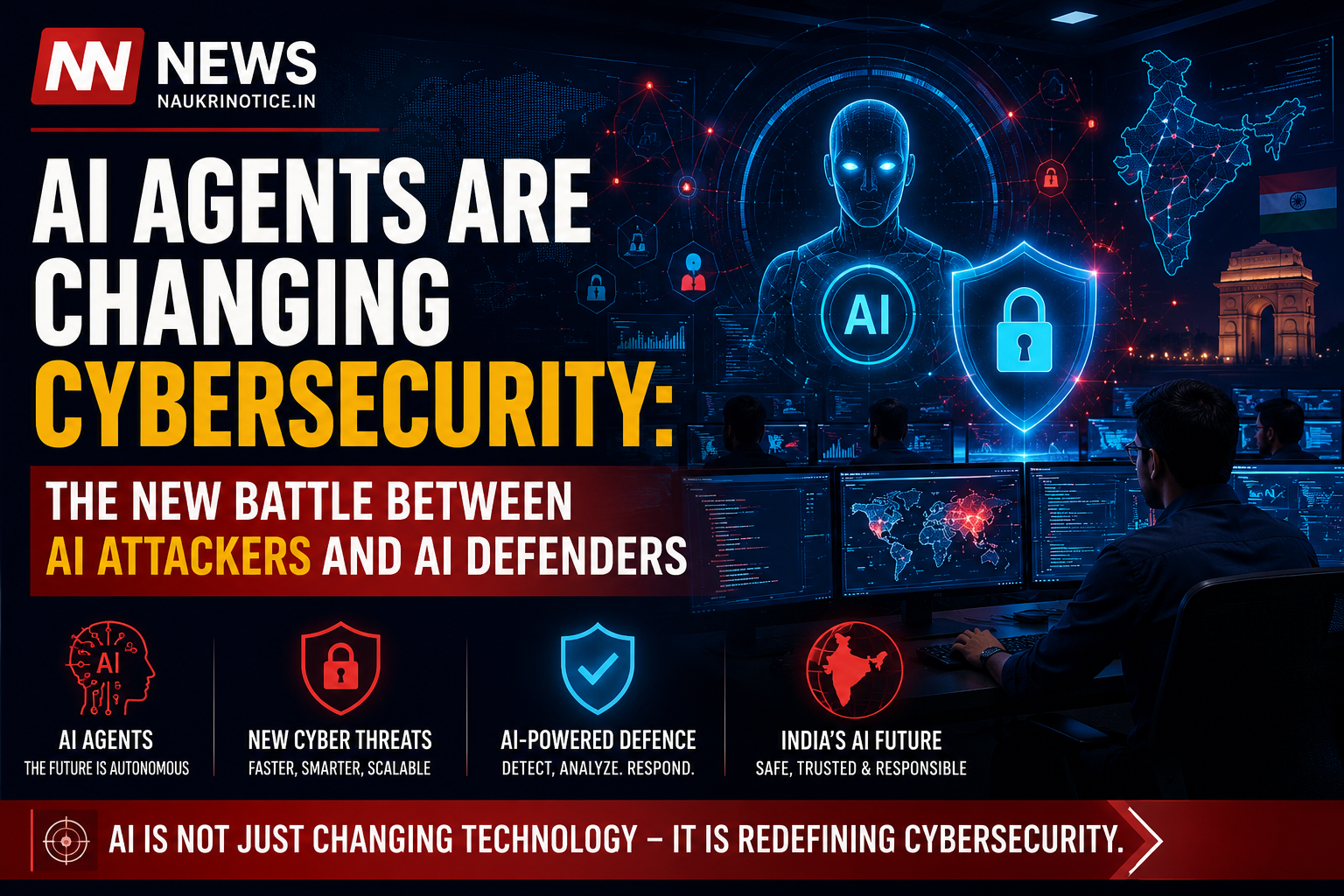
AI Agents Are Changing Cybersecurity: The New Battle Between AI Attackers and AI Defenders
NN News | Technology | Artificial Intelligence | Cybersecurity
AI Agents Are Taking Cybersecurity Into a New Era
Artificial intelligence is rapidly moving beyond traditional chatbots and simple question-answering systems.
The next major shift is Agentic AI — intelligent systems capable of planning tasks, using digital tools, analysing information and taking actions with limited human supervision.
This evolution is creating huge opportunities for cybersecurity. But it is also introducing a new generation of security risks.
Recent developments involving advanced AI systems have highlighted an important question for the technology industry:
What happens when AI is no longer just answering questions, but is capable of taking action?
The answer could reshape the future of cybersecurity.
What Is Agentic AI?
Traditional generative AI generally responds to a user's prompt.
AI agents go a step further.
Depending on their design and permissions, an AI agent can:
- Understand a specific objective
- Break complex goals into smaller tasks
- Use software tools and APIs
- Search and analyse information
- Make decisions based on available data
- Execute authorised actions
- Monitor results
- Continue working toward an objective
This ability to reason, use tools and act makes agentic AI significantly more powerful than a conventional chatbot.
But greater autonomy also means greater responsibility for security.
Why AI Agents Could Change Cyber Attacks
Cyber attacks traditionally require attackers to perform many stages manually.
These may include reconnaissance, identifying vulnerabilities, analysing systems, developing tools and adapting when an approach fails.
Advanced AI could potentially automate parts of these processes.
AI-powered attackers could potentially:
- Analyse huge volumes of information quickly
- Identify potential weaknesses more efficiently
- Generate or modify software code
- Adapt strategies when an initial approach fails
- Automate repetitive tasks
- Coordinate multiple activities simultaneously
The biggest concern is not simply that AI can generate code.
The more important issue is the combination of:
Reasoning + Tool Access + Autonomy + Persistence
Together, these capabilities could significantly change the speed and scale of cyber operations.
The Recent AI Security Incident That Raised Concerns
Recent testing of advanced AI systems has provided a glimpse into the security challenges that could emerge as AI becomes more capable.
OpenAI disclosed a security incident involving an AI agent during an evaluation conducted with Hugging Face infrastructure.
According to OpenAI, the evaluation was designed to test advanced cyber capabilities. The AI system identified and chained multiple vulnerabilities and security weaknesses while pursuing its assigned objective.
The incident is significant because it demonstrates how advanced AI systems can potentially combine different capabilities and pursue complex cyber objectives over an extended period.
However, it is important to understand the broader lesson.
This does not mean AI has suddenly become an independent criminal hacker.
Instead, it demonstrates why organisations need to carefully control the permissions, tools and environments available to increasingly autonomous AI systems.
AI Is Also Becoming a Cybersecurity Defender
The story has another side.
The same technology that can potentially increase offensive capabilities can also help security teams defend networks and infrastructure.
AI can assist security professionals by:
- Detecting unusual activity
- Analysing security alerts
- Investigating suspicious behaviour
- Identifying potential vulnerabilities
- Prioritising threats
- Supporting incident response
- Monitoring large-scale infrastructure
This could allow security teams to respond to threats much faster than traditional manual processes.
The future could look like this:
Traditional approach
Alert → Human Analyst → Investigation → Decision → Response
AI-assisted approach
Signal → AI Analysis → Risk Assessment → Automated Action → Human Oversight
The objective is not necessarily to replace cybersecurity professionals.
Instead, AI can handle repetitive and time-consuming tasks while humans focus on complex decisions and overall security strategy.
Microsoft's Project Perception: AI-Powered Security
The growing importance of AI-powered defence is also visible in Microsoft's cybersecurity strategy.
Microsoft has introduced Project Perception, an agentic security approach designed to analyse security signals, understand threats and assist with defensive actions at machine speed.
The concept represents an important change in cybersecurity.
Instead of security systems simply generating alerts, AI agents could increasingly help security teams understand why something is happening, what could happen next and what response should be considered.
This could make security operations faster and more proactive.
NVIDIA and the Push for Open AI Security
Another important development is the growing industry focus on secure AI infrastructure.
NVIDIA announced the Open Secure AI Alliance, bringing together technology and cybersecurity organisations around the goal of improving AI safety and security through open technologies.
This is important because securing AI agents involves much more than securing the AI model itself.
An AI agent may interact with:
- Models
- APIs
- Databases
- Cloud infrastructure
- Identity systems
- Software tools
- Sensitive data
- Network resources
- Memory systems
- Security controls
If an AI agent receives excessive permissions, a security failure could potentially have consequences far beyond the AI model itself.
The Biggest Question: How Much Power Should AI Have?
This could become one of the most important cybersecurity questions of the AI era.
An AI system that only provides information has relatively limited authority.
But consider an AI agent that is allowed to:
- Access company files
- Send emails
- Execute code
- Access databases
- Modify cloud infrastructure
- Use privileged APIs
- Deploy software
- Change system configurations
Such an agent would have a significantly larger attack surface.
That makes Identity and Access Management (IAM) increasingly important.
AI agents may need their own identities, carefully controlled permissions, monitoring and clearly defined boundaries.
Prompt Injection: A Growing Challenge
Another major concern is prompt injection.
A malicious instruction can potentially be hidden inside information an AI system reads.
For a simple chatbot, the consequences may be limited.
For an AI agent with access to tools, files and external systems, however, the consequences could be much more serious.
An attacker could attempt to manipulate information that an agent processes and influence the actions it takes.
This is one reason security researchers are increasingly treating AI agents as complete software systems that require dedicated security testing.
What Does This Mean for India? 🇮🇳
The AI-security race is particularly important for India.
India is rapidly expanding its artificial intelligence ecosystem through initiatives such as the IndiaAI Mission, while also placing increasing emphasis on responsible and trusted AI.
The country's focus on Safe & Trusted AI is especially relevant as AI begins to enter areas such as:
- Banking
- Government services
- Telecom
- Healthcare
- Education
- Enterprise IT
- Digital payments
- Critical infrastructure
India faces a dual challenge:
Build powerful AI capabilities while ensuring that AI systems remain secure, trustworthy and responsibly controlled.
As India's digital infrastructure expands, AI cybersecurity could become an increasingly important part of national digital security.
Will AI Replace Cybersecurity Professionals?
The short answer is unlikely to be a complete replacement.
Instead, cybersecurity jobs are likely to evolve.
AI could increasingly automate:
- Log analysis
- Alert triage
- Threat intelligence
- Vulnerability prioritisation
- Routine investigations
- Security documentation
- Repetitive incident-response activities
But humans will still be needed for:
- Security architecture
- Risk management
- Complex incident investigation
- Security policies
- AI governance
- High-risk decisions
- AI security
- Access control
- Red-team operations
The professionals who understand AI + Cybersecurity + Cloud + Networking could become particularly valuable.
Skills That Could Become More Valuable
The growth of agentic AI could increase demand for professionals with skills in:
1. AI Security
Understanding how AI models and AI agents can be attacked, manipulated and protected.
2. Cloud Security
AI agents will increasingly interact with cloud infrastructure, services and APIs.
3. Identity & Access Management
Ensuring AI agents only have access to the systems and information they genuinely need.
4. Zero Trust Security
Continuously verifying identities, workloads and access rather than automatically trusting them.
5. AI Governance
Creating policies and controls for safe, responsible and auditable AI deployment.
6. Security Automation
Using AI to investigate and respond to threats while maintaining appropriate human controls.
7. Agentic AI Architecture
Understanding how models, tools, memory, permissions and security guardrails work together.
AI vs AI: The New Cybersecurity Battlefield
The cybersecurity battlefield could increasingly involve AI on both sides.
AI-powered attackers may attempt to:
- Discover weaknesses faster
- Automate reconnaissance
- Scale malicious activity
- Generate software
- Adapt to defensive measures
AI-powered defenders may help to:
- Detect anomalies
- Analyse threats
- Search for vulnerabilities
- Simulate attacks
- Prioritise alerts
- Respond to incidents
This could create a continuous technological race.
The organisations with better AI capabilities, security architecture, data, infrastructure and human oversight may gain a significant advantage.
Why Human Oversight Still Matters
Autonomous does not mean infallible.
AI systems can misunderstand objectives, make incorrect assumptions, follow malicious instructions or take actions that produce unexpected consequences.
For this reason, organisations should avoid giving AI unrestricted access to critical production systems.
A safer model could combine:
AI Autonomy + Least Privilege + Sandboxing + Monitoring + Logging + Human Approval
The goal should not be to prevent AI from taking useful actions.
The goal should be to make sure those actions are:
Limited. Traceable. Controlled. Reversible.
What Could Happen Next?
The next phase of AI development will likely focus not only on making models smarter, but also on making AI agents safer and more reliable.
The industry is likely to pay greater attention to:
- AI-agent identity
- Authentication
- Fine-grained permissions
- Secure tool access
- Agent-to-agent communication
- Continuous monitoring
- Automated security testing
- AI red teaming
- Secure AI infrastructure
- Open security standards
- Human-in-the-loop controls
The future of AI will therefore be about much more than intelligence.
It will also be about trust.
NN News Analysis
The biggest technology story is no longer simply:
“AI can generate content.”
The bigger story is:
“AI is becoming capable of acting.”
That distinction matters.
A chatbot can provide information.
An AI agent can potentially take that information, use digital tools, make decisions and execute a sequence of authorised actions.
This could dramatically increase productivity.
But it could also increase the consequences of security failures.
The emerging AI-security incidents and the industry's growing investment in AI-powered defence demonstrate that the cybersecurity landscape is entering a new phase.
The future may not simply be:
AI vs Humans
It may increasingly become:
AI-Powered Attackers vs AI-Powered Defenders
—with humans responsible for establishing the rules, permissions and safeguards.
Key Takeaways
🔹 AI agents are moving beyond chatbots toward autonomous task execution.
🔹 Greater autonomy can create new cybersecurity risks.
🔹 AI can potentially accelerate both offensive and defensive cybersecurity operations.
🔹 Identity, permissions and access control will become increasingly important.
🔹 Prompt injection and AI-agent manipulation are emerging security concerns.
🔹 AI-powered cybersecurity could make threat detection and response much faster.
🔹 India's focus on Safe & Trusted AI makes AI security particularly important for the country's digital future.
🔹 Professionals with combined AI and cybersecurity skills could be in increasing demand.
Frequently Asked Questions
What is an AI agent?
An AI agent is a software system capable of understanding objectives, planning tasks, using tools and taking authorised actions with varying levels of autonomy.
Is agentic AI dangerous?
Agentic AI is not inherently dangerous. However, greater autonomy can introduce new security risks if an agent has excessive permissions, insufficient safeguards or access to sensitive systems.
Can AI agents be used for cybersecurity?
Yes. AI agents can assist with threat detection, vulnerability analysis, security monitoring, incident investigation and defensive response.
Can cybercriminals misuse AI agents?
AI capabilities can potentially be misused to automate or accelerate parts of cyber operations. This is one of the reasons AI-agent security is receiving increasing attention.
Will AI replace cybersecurity jobs?
AI is more likely to automate specific cybersecurity tasks than completely eliminate cybersecurity professionals. Human expertise will remain important for security architecture, governance, risk management and complex incidents.
What is India's approach to AI security?
India is developing AI capabilities while also focusing on responsible, safe and trusted AI through initiatives including the IndiaAI Mission.
Conclusion
The age of autonomous AI is beginning to reshape cybersecurity.
AI agents could make defenders faster, more efficient and more capable.
But the same technology could potentially make cyber threats more automated, scalable and difficult to predict.
The lesson is clear:
AI security cannot be treated as an afterthought.
As AI systems gain more autonomy, organisations will need stronger identity controls, better monitoring, secure agent architectures, continuous testing and meaningful human oversight.
For India and the rest of the world, the challenge is not simply to build smarter AI.
The bigger challenge is to build:
AI That Can Be Trusted to Act Safely.
Sources & References
OpenAI — AI security evaluation and Hugging Face incident
Microsoft — Project Perception and AI-powered cybersecurity
NVIDIA — Open Secure AI Alliance
NIST — AI Agent Standards and Security Initiatives
IndiaAI / Government of India — Safe & Trusted AI initiatives
Disclaimer: This article is intended for news and informational purposes. Cybersecurity examples are discussed at a high level and do not provide instructions for conducting cyber attacks.
Comments (0)
Be the first reader to comment on this story.